Mastering Money: 20 Essential Investment Terms Every Beginner Should Know
A plain-language glossary of 20 essential investing terms - stocks, bonds, ETFs, P/E ratio, market cap, yield and more - each with a concrete worked example.

Naif Asswiel··7 min read
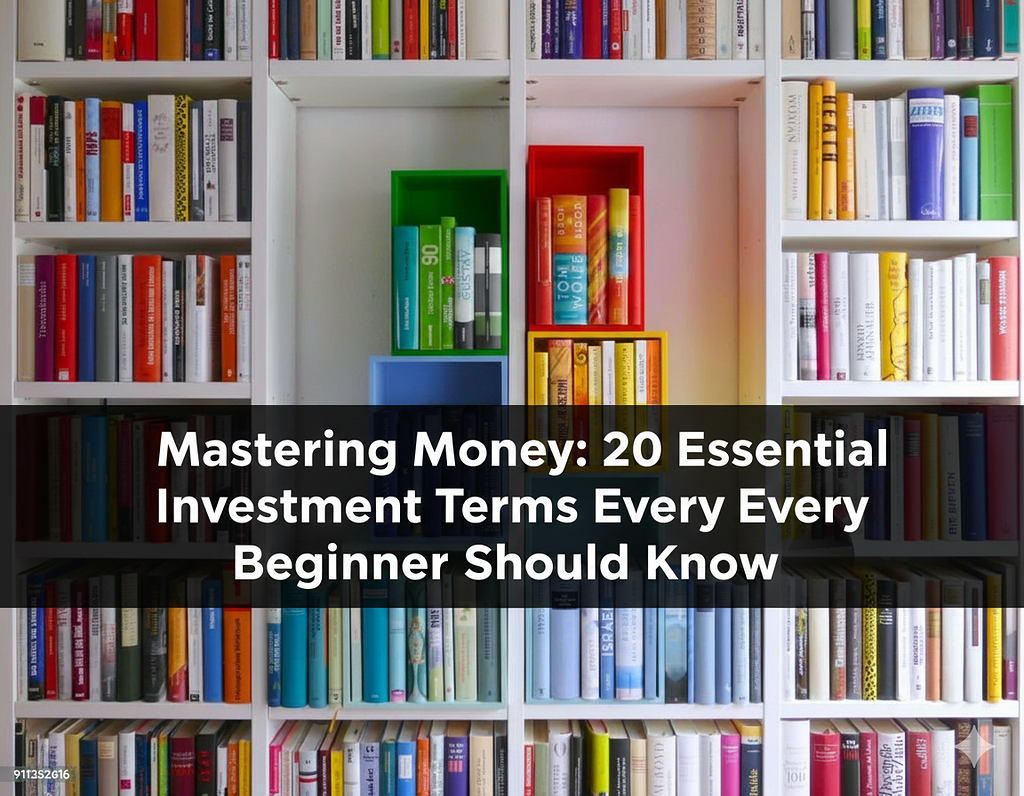
Understanding investment terms is the first step to taking control of your financial future. In this guide, you'll learn the key concepts that shape the world of investing, from stocks and bonds to ETFs and venture capital. By the end, you'll gain the confidence to navigate financial markets with clarity and insight.
1. Stock (Share)
A fractional unit of ownership (equity) in a corporation, which grants the holder the right to receive distributed earnings, such as dividends.
Example: If you buy 10 shares of Microsoft, you own a small fraction of the company and are entitled to a portion of its profits.
2. Bond
A loan made by an investor to a borrower (typically a company or government) that pays fixed interest over time and repays the principal amount at a future date.
Example: An investor bought a U.S. Treasury bond (T-bond) with a face value of $1,000 that is due in 30 years, with an annual interest rate of ~4.625%, they will receive $23.125 as interest on the bond every six months until the maturity day.
3. Liquidity
The degree to which an asset can be quickly bought or sold in the market without affecting its market price.
Example: Cash is the most liquid asset. Shares of large-cap stocks are highly liquid, while a piece of real estate is relatively illiquid.
4. Portfolio
A collection of financial assets like stocks, bonds, cash, and real estate held by an investor.
Example: An investor's portfolio might consist of $20,000 in various stocks, $10,000 in government bonds, and $5,000 in real estate.
5. Returns
The gain or loss of money on an investment over a specific period, expressed as a percentage of the initial investment cost.
Example: An investor bought one stock of Apple in January 2024 at $182.67 and sold it in January 2025 at $235.17. The returns over the year are calculated with (New Price - Old Price) / Old Price * 100. In our case ($235.17 - $182.67) / $182.67 * 100 = 28.74%. The investor made approximately 28.74% of returns over that year.
6. Dividend
A portion of a company's profits paid out to its shareholders, typically in cash on a quarterly basis.
Example: For the last quarter of 2025, the dividend Apple declared was $0.26 per share. If an investor owns one share of Apple, they will receive that amount for the fourth quarter of 2025.
7. P/E Ratio (Price-to-Earnings Ratio)
A valuation metric calculated by dividing a company's stock price by its earnings per share (EPS). It indicates what the market is willing to pay for a company's earnings. It is usually calculated over 12 months.
Example: On November 17, 2025, the closing price for Apple stock was $267.46. The company's previous twelve-month Earnings Per Share (EPS) at that time was $7.47. Apple's P/E ratio = $267.46 / $7.47 = 35.8. This means investors were willing to pay $35.8 for each dollar of Apple's earnings.
8. Market Capitalization (Market Cap)
The total market value of a company's outstanding shares, calculated by multiplying the share price by the number of shares.
Example: Apple has 14.773 billion outstanding shares. The market cap of Apple on November 17, 2025 = $267.46 x 14.773 billion = $3.951 trillion.
9. Volatility
A measure of how much a stock's price swings up and down. High volatility means the price is making big, fast changes, while low volatility means the price is stable. It essentially measures the risk and uncertainty of a stock's price movements.
Example: The volatility calculation requires a few technical steps that are beyond the scope of this topic.
10. Yield
The income return on an investment (often for bonds), such as the interest or dividends received. It is usually expressed as an annual percentage based on the investment's cost or market value.
Example: The Yield on the U.S. Treasury T-bond mentioned before is 4.625%. Basically, the Yield is the interest rate of a bond.
11. Broker
A firm or an individual that acts as an intermediary, who facilitates the buying and selling of securities for investors in exchange for a fee or commission.
Example: To buy shares of Tesla, the investor must open an account with a broker like Fidelity, eToro, or XTB.
12. Mutual Fund
An investment vehicle that pools money from many investors to purchase a diversified portfolio of stocks, bonds, or other securities, with the aim of outperforming the market (an index).
Example: Fidelity Magellan Fund (FMAGX), which is actively managed by Fidelity. This mutual fund aims to outperform the S&P 500 index.
13. Stock Market Index
A benchmark used to measure the performance of a group of stocks that represents a particular market or sector.
Example: The S&P 500 index which represents the largest 500 companies in the U.S., or the FTSE 100 which represents the largest 100 companies in the UK.
14. Index Fund
A type of mutual fund with a portfolio constructed to match or track the components of a financial market index, such as the S&P 500.
Example: The Vanguard 500 Index Fund (VFIAX) holds shares in all 500 companies in the S&P 500, allowing you to invest in the broad U.S. market with a single fund.
15. Hedge Fund
A private investment pool that uses active, often aggressive and risky strategies to generate high absolute returns for its investors. Hedge funds are usually open only to accredited or institutional investors, are less regulated than mutual funds, and typically charge higher fees.
Example: Bridgewater Associates, which invests in stocks, bonds, currencies, and other assets, has its own private investing strategies. To invest with them, you typically need a minimum commitment of several million dollars.
16. Expense Ratio
An annual fee charged by mutual funds, index funds, and ETFs, expressed as a percentage of the fund's total assets, to cover operating costs.
Example: The Vanguard 500 Index Fund (VFIAX) expense ratio is 0.04%.
17. ETF (Exchange-Traded Fund)
A type of security that tracks an index, sector, or other asset, but which can be purchased or sold on a stock exchange the same as a regular stock.
Example: An investor can buy shares of the Vanguard S&P 500 ETF (VOO), which tracks the S&P 500 index.
The core differences between an ETF and a normal stock:
- ETFs are traded throughout the day; an investor can buy or sell an ETF at any time during market hours. In contrast, shares of mutual funds and index funds are only traded at the closing price of the day.
- ETFs are traded on the stock market; if an investor sells an ETF, another investor will eventually buy it. In contrast, when buying shares of an index fund or a mutual fund, the investor buys shares directly from the fund company.
- ETFs generally have lower expense ratios than index funds and mutual funds.
18. Net Asset Value (NAV)
The per-share market value of a mutual fund or ETF, calculated by dividing the total value of all assets in its portfolio, minus liabilities, by the number of shares outstanding.
Example: A mutual fund with $100 million in assets, $5 million in liabilities, and 10 million shares has a NAV of: ($100 million - $5 million) / 10 million = $9.50 per share.
19. Venture Capital (VC)
A form of private equity financing provided by venture capital firms to startups, early-stage, and emerging companies that have high growth potential.
Example: A new technology startup receives $5 million from a VC firm in exchange for an ownership stake, using the funds to scale its operations.
20. Asset Allocation
The strategy of dividing an investment portfolio among different asset categories, like stocks, bonds, and cash, to balance risk and reward.
Example: A young investor might adopt an aggressive asset allocation of 90% stocks and 10% bonds, while a retiree might choose a conservative allocation of 30% stocks and 70% bonds.
Disclaimer: All figures mentioned above are as of November 17, 2025 and may change over time. Significant variations of the concepts have been omitted to keep the topic simple for beginners.
Share this post
Keep reading
More from the notebook




Newsletter
Get new posts in your inbox
Plain-language notes on AI, prompt engineering, and money. No spam, unsubscribe anytime.